LP-747

Lou Donaldson - Cole Slaw


Released 1965

Recording and Session Information


Lou Donaldson, alto saxophone; Herman Foster, piano; Earl May, bass; Bruno Carr, drums; Ray Barretto, conga
RCA Recording Studios, New York, June 19 1964

13287 O sole mio
13288 Cole slaw
13289 Poinciana
13290 Soul gumbo
13291 There is no greater love
13292 People will say we're in love
13293 Li'l miss Fine
13294 Skylark

Track Listing

There Is No Greater LoveIsham Jones/Matty SymesJune 19 1964
PoincianaNat Simon/Buddy BernierJune 19 1964
Cole SlawJessie StoneJune 19 1964
People Will Say We'Re In LoveRodgers/Hammerstein IIJune 19 1964
Li'L Miss FineLou DonaldsonJune 19 1964
O Sole MioArr. Lou DonaldsonJune 19 1964
SkylarkHoagy Carmichael/John H. MercerJune 19 1964
Soul GumboLou DonaldsonJune 19 1964

Liner Notes

THE ALTO SAXOPHONE, until Charlie Parker came along, was considered to be the exclusive property of Johnny Hodges. Ever since the era of Bird, however, more and more practitioners have sought to make this difficult instrument the one on which they've tried to express their musical opinions. There are as many styles as there are musicians, but only a handful have really stuck to the line that the genius of modern music laid down. Of that handful, two major artists have survived the many musical changes that have befuddled the lesser talents, One of them is Sonny Stitt. The other is the featured artist of this album, Lou Donaldson!

Lou Donaldson first burst upon the recorded scene in the late '40's as featured hornman with Milt Jackson on some Blue Note 78's, including the memorable "Bag's Groove". With were some very top flight musicians — John Lewis, Percy Heath, and Kenny Clarkc — indeed, the first version of the reknowned Modern Jazz Quartet. Those recordings made a lasting impression, and signalled the jazz world that Lou Donaldson was here te stay. Lou has made many fine albums on his own since that time, including his two Argo releases, "SIGNIFYIN'" #724, and "POSSUM HEAD' #734. I'm of the opinion that this one is the swinginest and most musical of them all. For Lou exhibits herein his particular talent of getting right to the meat and marrow of the selections plaed. This talent, quiet as it's kept, has permitted Lou Donaldson to be one of the musicians around. Because of this highly rhythmical and straightforward approach to Jazz, Lou has been able to reach and satisfy a much wider audience than most of his contemporaries who are more likely than not chained to a particular hit tune, gimmic sound, or far-out style. His travelling group usually includes organist John Patton and the excellent trumpeter Bill Hardman. For this album, however, Lou is accompanied and wonderfully aided by a really fine rhythm section, headed by pianist Herman Foster. Herman's comping and solo work is very outstanding, and his locked-hands style is perfect for the kind of groove laid down for this session. Bassist is Earl May, who unobtrusively but firmly keeps the melodic beat where it should be and walks mightily on several numbers. Bruno Carr proves to be a drummer of exquisite taste, regardless of the tempo or style being used. Congero Ray Barretto is added for the latin touches.

Side one opens with a tune that's great to blow — the standard "THERE IS NO GREATER LOVE". A bongo-type beat sets the groove for Lou who sings out the pretty theme, after which Foster's piano lays into the beat with May's bass walking along and really digging in behind Lou's solo. It's a real head shaker!

"POINCIANA" is latinized all the way, with the piano solo coming on in true south-of-the-border style.

"COLE SLAW", the album's title tune, was known as "Sourghum Switch" during the "swing era", and later recorded by Louis Jordan as "COLE SLAW'". Its rhythmic pattern is back-beat-ish and it has a happy dance tune feel to it.

"PEOPLE WILL SAY WE'RE IN LOVE" is in medium-up tempo with Lou jumping right into the melody with another outstanding solo, followed by a delightful piano offering with May's pulsating throughout the happy proceedings.

"L'IL MISS FINE" opens side two in the traditional Kansas City blues style that first made Charlie Parker a musician. On the second chorus Lou really gets to stomping, after which Foster gets to rockin', and the rhythm section goes right with him. Earl May's only bass solo of the set one wonderful structure and great taste.

Neapolitan nighs are not particularly brought to light with Lou's treatment of the older-than-old "O SOLE MIO", but the tune does lend itself to produce one of the finest solos he's ever recorded.

"SKYLARK", played nearly straight, exhibits the singing, straight-forward style previously mentioned as being one of Lou's oustanding assets.

And the final tune, "SOUL GUMBO", is a stompy little riff-type item that's almost "twisty".

With albums of this swinging quality, and his audience-pleasing, in-person appearances throughout the country leading the way, it fairly certain that LOU DONALDSON, as the title on another of those early 78's states, definitely remain "On The Scene" for a long time to come. His music is ageless!

Joe Segal
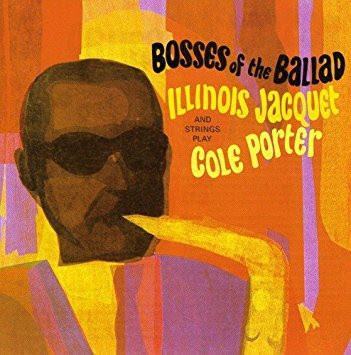
LP-746

Illinois Jacquet - Bosses of the Ballad


Released 1964

Recording and Session Information


Illinois Jacquet, tenor saxophone; 18 strings, woodwinds, harp, french horns and rhythm, Benny Golson, Tom McIntosh, arranger
Regent Sound Studios, New York City, October 29 + 30 1964

13521 Begin the beguine
13522 All through the night
13523 Use your imagination
13524 It's all right with me
13525 Do I love you?
13526 I've got you under my skin
13527 So in love
13528 Get out of town
13529 I love you
13530 I concentrate on you
13531 You do something to me
13532 Every time we say goodbye

Track Listing

I Love YouCole PorterOctober 29 + 30 1964
Get Out Of TownCole PorterOctober 29 + 30 1964
So In LoveCole PorterOctober 29 + 30 1964
I Concentrate On YouCole PorterOctober 29 + 30 1964
You Do Something To MeCole PorterOctober 29 + 30 1964
Everytime We Say GoodbyeCole PorterOctober 29 + 30 1964
Use Your ImaginationCole PorterOctober 29 + 30 1964
All Through The NightCole PorterOctober 29 + 30 1964
Begin The BeguineCole PorterOctober 29 + 30 1964
It's All Right With MeCole PorterOctober 29 + 30 1964
Do I Love YouCole PorterOctober 29 + 30 1964
I've Got You Under My SkinCole PorterOctober 29 + 30 1964

Liner Notes

COLE PORTER'S fabulous talent has left an indelible effect on the American popular music and musical comedy scene. Yet the use of his enormous output by jazz artists has been curiously limited. Tentative explanations for this neglrct have not been convincing. One of these, offered by one of the most discerning avd productive jazzmen, might offer a clue to the mystery. "Cole Porter", he said, "was a tremendous composer, but his tunes were written mainly for use in the theater. His melodic lines were unusually long, and perhaps this fact discouraged jazz musicians from making greater use of them." Whatever the reason may be, the fact is that except for a handful of Cole Porter compositions, his repertoire has been largely ignored by jazz instrumentalists. This album proves conclusively that there was no musically valid reason for this omission.

ILLINOIS JACQUET is an accomplished ballad interpreter in his own right, but never before has he recorded so many ballads at one time. He has recorced ballads before, but not more than one or two in an album. During night club engagements he sprinkles his ballads gingerly, one or so to every half dozen tunes. Nevertheless, some of his most successful recordings have been ballad tunes. During the early 1940' Illinois scored strongly with a particularly exquisite recording of the ballad "I Don't Sand A Ghost Of A Chance With You". This was followed by "Memories Of You", recorded after gruelling, though commercially-rewarding tours of duty with the Lionel Hampton and Cab Calloway bands. In the 1964 Argo album "DESERT WINDS", he included the ballad "You're My Thrill" in a poignant performance.

Jacquet, one of the most disciplined and self-demanding of musicians, has given deep thought and study to the ballad. "The ballad is the most demanding test of jazz performers", he believes. "Musicians playing ballads require an exceptional ear. The instrumentalist must possess a full, rich tonal quality that comes only after long training. When I play a ballad, I approach it the way a singer would. I read the lyrics over and over, and then I try to interpret their meaning through my instrument: Jacquet regards this album as a significant departure from the norm for him. "The ballad soothes the heart when properly played", he explains. "It is supposed to induce romance. And there is a great need for peace in our world, and for love."

Illinois Jacquet was 16 years old, and playing spiritedly, though not with his present brilliance and maturity, in the orchestra of the all-Negro Phyllis Wheatley High School in Houston, Texas, when he first made musical contact with the genius of Cole Porter. Jacquet was then playing a B flat soprano saxophone, and also first alto, in the orchestra's reed section. He admired Cole Porter in his youth as a prolific compose€ and a rare musical talent. "Cole Porter was a master of the ballad form", he says. "His music is melodically exciting and moving. He felt his melodies. Porter's music conveyed tremendous feeling. I knew the man, Cole Porter, only through his tnusic, but it was a warm, close, and fascinating friendship."

Cole Porter had won world fame as a composer and lyricist long before his death. Porter lived a life of alrnost baroque elegance, made possible by inherited wealth, and had cultivated expensive tastes. Music to him was more a hobby, and an outlet for his enormous creative energies, than a means of livelihood. He wrote sumptuous scores for numerous Broadway musicals and films, and his tunes were hummed and sung by millions. Between World Wars 1 and 2, he gravitated gaily between America and Europe, consorting with a slick, super-charged international set which was addicted to a glossy high life. In those free and frivolous, but highly productive years, his hone base was mainly Paris — where he maintained a luxurious home on the teaming and tumultuous Left Bank. In 1919. he settled in Paris with his new wife. Although Paris, the French Riviera, and Venice were his favorite playgrounds, all Europe was his territory and he explored it in exotic fashion. Many of his most famous songs, which breathe America so intimately, were actually written in places like Paris, Rome, or on a yacht cruising up the Rhine. Porter was a fabulous gourmet with an enormous zest for life, and did not permit his appallingly active social schedule to blunt his creative process.

Porter was admired for his craftsmanship by the most distinguished writers of his time. Perhaps the greatest praise of all came from Richard Rodgers, who said: "Few people realize how architectually excellent his music is. There's a foundation, a structure, and an embellishment. Then you add the emotion he's put in, and the result is Cole Porter."

Born on a farm in Peru, Indiana, Porter played the violin at six, the piano at eight, and when he was ten composed his first published song, "The Bobolink Waltz". He was educated at the fashionable Worchester Academy in Massachusetts, at Yale, and at Harvard, where he studied both law and music. Porter's life differed from that of most American composers in that he never had to face the bitter battle to earn a living from his music. A wealthy family solved that problem for him. His father, Samuel Fenwick Porter, was a prosperous fruit grower, and his maternal grandfather, J. O. Cole, had struck it rich in the lumber business. After college, Porter devoted himself somewhat arrogantly to a life of ease, elegance, pleasure and casual musical creation.

He was a master of the ballad form which he employed delightfully — both musically and ivrically. His scores for Broadway musicals are studded with some of the greatest hits in musical history. The ballads which comprise this album are played with imagination and taste. All were written for a series of Broadway shows beginning in 1928 with "PARIS", (which was really a play with music) and concluding in 1955 with "SILK STOCKINGS". In the intervening years, Cole Porter wrote scores for such musicals as "FIFTY MILLION FRENCHMEN" (1929), "THE NEW YORKERS" (1930), "WAKE UP AND DREAM" (1929), "ANYTHING GOES" (1934), "JUBILEE" (1933), "RED, HOT AND BLUE" (1936), "LEAVE IT TO ME" (1938), "DUBARRY WAS A LADY" (1939), "PANAMA HATTIE" (1940). "SOMETHING FOR THE BOYS" (1943), "MEXICAN HAYRIDE' (1944), "KISS ME KATE" (a 1948 musical interpretation of Shakespeare's Taming Of The Shrew". which was his most stunning commercial triumph) "CAN-CAN" (1953) and "SILK STOCKINGS" (1957) which closed an astonishing career of writing brilliant scores for musical comedies.

Pain darkened and saddened Cole Porter's last years. Crippled, as a result of a riding accident in 1937, he underwent thirty operations in twenty years, culminating in the amputation of his right leg in 1938. What once was a life of hectic pleasure, changed to a harsh and physically miserable existence. He withdrew from the world of fun and excitement he had loved so much. When Porter died at the age of 72, (on October 15, 1964) Esmond Edwards of Argo Records, a long-time Cole Porter admirer, decided that one significant way to memorialize Porter would be to have his works interpreted by a jazz artist of stature. Illinois Jacquet, one of the acknowledged 'bosses" of the tenor saxophone, was selected to explore a series of Cole Porter ballads. This album represents the musical summation of Jacquet's findings.

One final word of admiring acknowledgement is in order for two gifted orchestrators responsible for the arrangements. Benny Golson arranged and conducted "GET OUT OF TOWN", "SO IN LOVE", "I CONCENTRATE ON YOU", "EVERYTIME WE SAY GOODBYE", "ALL THROUGH THE NIGHT", "IT'S ALL RIGHT WITH ME" and "DO I LOVE YOU". Tom McIntosh, the brilliant trombonist-arranger, orchestrated and conducted "I LOVE YOU', "I'VE GOT YOU UNDER MY SKIN", "YOU DO SOMETHING TO ME", "BEGIN THE BEGUINE" and "USE YOUR IMAGINATION'.

Tempos range from the slow and subdued, to the lively and exuberant. Jacquet continually weaves lush tapestries on the melodic structures created by Cole Porter. His interpretations are richly evocative of the composer, and form a sentimental man whose life has become a fable of our times.

ALLAN MORRISON
New York Editor
EBONY MAGAZINE

LP-745

The Ramsey Lewis Trio - More Sounds of Christmas


Released 1964

Recording and Session Information


Ramsey Lewis, piano; Eldee Young, bass; Redd Holt, drums; John Avant, trombone; Sol Bobrov, David Chausow, Henry Ferber, Irving Kaplan, Mark Konorad, Harold Kupper, Abe Meltzer, Albert Muenzer, Harold Newton, Theodore Ratzer, Everett Zlatoff-Mirsky, strongs; Pete Eagle, harp; King Fleming, Will Jackson, arrangers
Universal Recording Studio, October 14 1964

13476 Snowfall
13477 Rudolph the red-nosed reindeer
13478 Snowbound
13479 The twelve days of Christmas
13480 Little drummer boy

Ramsey Lewis, piano; Eldee Young, bass,cello; Cleveland Eaton, bass; Steve McCall, drums
Universal Recording Studio, October 15 1964

13481 We three kings
13482 White Christmas
13483 Egg nog
13484 Jingle bells
13485 Plum puddin'

Track Listing

SnowboundRussel Faith/Clarence KehnerOctober 14 1964
The Twelve Days Of ChristmasLewis/Edmonds arrOctober 14 1964
Egg NogRamsey LewisOctober 15 1964
Rudolph, The Red Nosed ReindeerJohn D. MarksOctober 14 1964
Jingle BellsJ. Pierpont /arr YoungOctober 15 1964
Plum Puddin'Eldee YoungOctober 15 1964
SnowfallClaude ThornhillOctober 14 1964
We Three KingsRamsey Lewis arrOctober 15 1964
White ChristmasIrving BerlinOctober 15 1964
Little Drummer BoyDavis/Onorati/SimeoneOctober 14 1964

Liner Notes

IN THE MOOD of Yuletide, snow flurries, and good tastin'— three kings, (Ramsey Lewis, Eldee Young, and Red Holt) tell it like it is! They make merry music with piano, bass and drums mounted in a sleigh full of strings, and "go, go, go" with the spirit of Christmas and good jazz.

One good thing about this stocking full of goodies — it will outlive the holiday season. "TWELVE DAYS OF CHRISTMAS", "JINGLE BELLS", "WE THREE KINGS" et al, Ramsey and company make for year-round good listening.

Two good things about this album are the talented arrangers, King Fleming and Will Jackson. These Chicagoans have combined forces to produce arrangements that compliment the trio's style, and add new lustre to familiar tunes.

Three good things about "More Sounds of Christmas" are Ramsey, Eldee and Red. These young men continually display their unique ability to make any kind of tune their own. They have adapted classical tunes to their style, (BACH TO THE BLUES) bossa nova tunes, (RAMSEY LEWIS TRIO — BOSSA NOVA) and country & western tunes, (COUNTRY MEETS THE BLUES). Whatever the source of the material, the trio makes it a swinger or a lyrical thing of beauty with their personal hallmark.
A fourth good thing is drummer Steve McCall, who filled in for Red Holt (no small feat) on all sides featuring the trio without strings. When Red was unfortunately unable to make the session, Steve was called on short notice. Although he had never played with Ramsey or Eldee before, he performed admirably, and the feeling of swinging togetherness was preserved.

The beautiful "SNOWBOUND" is given a sensitive reading by Ramsey, with the rich string sounds of the Fleming/Jackson arrangement lending fine counterpoint.

Forget all the mediocre arrangements you've heard of "TWELVE DAYS OF CHRISTMAS." This one moves! From the "round" beginning with the cello and celeste, it picks up momentum when Ramsey switches to piano for his solo and later fades out wailing.

While we're on the subject of the celeste, how about the hip-swinging, foot-tapping celeste work on "EGG NOG"! Here again Ramsey does his solo work on the piano — and work he does! This egg nog is a potent brew reserved for serving to the "cool ones."

And how about Eldee Young's rollicking version of "JINGLE BELLS"! No "one horse open sleigh" for him; his cello is rocket propelled and soon gets into orbit with Eldee humming along. Eldee's cello outings on the trio's albums have been consistent favorites with the fans, and "BELLS" will be swinging on many turntables.

"SNOWFALL" is strictly for lovers, embraces. fireplaces, and if you're in the mood...some slow dances. "LITTLE BOY" grows up under the fast, skilled hands of Red Holt; and "PLUM PUDDIN'" has obviously been soaked with a heady brandy, or maybe more likely, some corn "likker." It has that down-home Christmas feeling.

God Rest Ye Merry Gentlemen, and thanks, Trio! Rest your ears on this beauty! is no "Ho, Ho, Ho" here...it's all "Yeah, baby!

Louise D. Stone
Jazz Columnist
Chicago Daily Defender

LP-759

Lou Donaldson – Musty Rusty Released 1965 Recording and Session Information Bill Hardman, trumpet; Lou Donaldson, alto saxophone; Bil...